
Introduction
As hotels evolve to meet new guest expectations, lighting design has shifted from decorative afterthought to a strategic driver of brand experience and operational performance. For architects and hotel designers specifying fixtures at scale, 2026 brings a refined spectrum of trends — from austere minimalism to layered, bespoke luxury — while intensifying commercial pressures around quality, lead time, certification, and sustainability. This article distills actionable intelligence for commercial buyers and design teams: how to translate aesthetic trends into technical specifications, mitigate procurement risks, and ensure installations achieve both mood and measurable performance.
Key Industry Insight
The strongest hospitality lighting designs of 2026 marry two parallel imperatives: atmospheric finesse and industrial robustness. A facade or suite that reads beautifully on a design board is only as valuable as the fixtures’ ability to deliver consistent color, long-term lumen maintenance, and predictable lead times across multiple properties.
- Aesthetic spectrum: Minimalism continues to influence lobbies and corridors through clean lines and concealed sources, while premium guestrooms and destination restaurants embrace sculptural fixtures and layered accent lighting to define brand narratives.
- Operational demands: Hotels require fixtures that simplify maintenance (tool-less access, modular optics), reduce downtime (longer lifetimes, pre-programmed controls), and meet global regulatory standards for safety and energy.
- Procurement reality: Architects must specify not only form and photometry but also supply-chain commitments — batch consistency, available spares, and contingency production capacity to avoid costly delays.
Below, we break these themes into design and technical guidance tailored to commercial projects.
Minimalism vs. Luxury: Translating Trends into Specifications
Minimalism
- Design language: Recessed linear optics, slender downlights, and integrated cove systems that disappear into architecture.
- Spec priorities: tight beam control, shallow ceiling plenum compatibility, low-profile drivers, glare-control louvres.
- Material/finish: anodized aluminium and matte powder coats that resist scuffing; verification of finish durability (salt-spray tests for coastal projects).
Luxury & Sculptural Accent
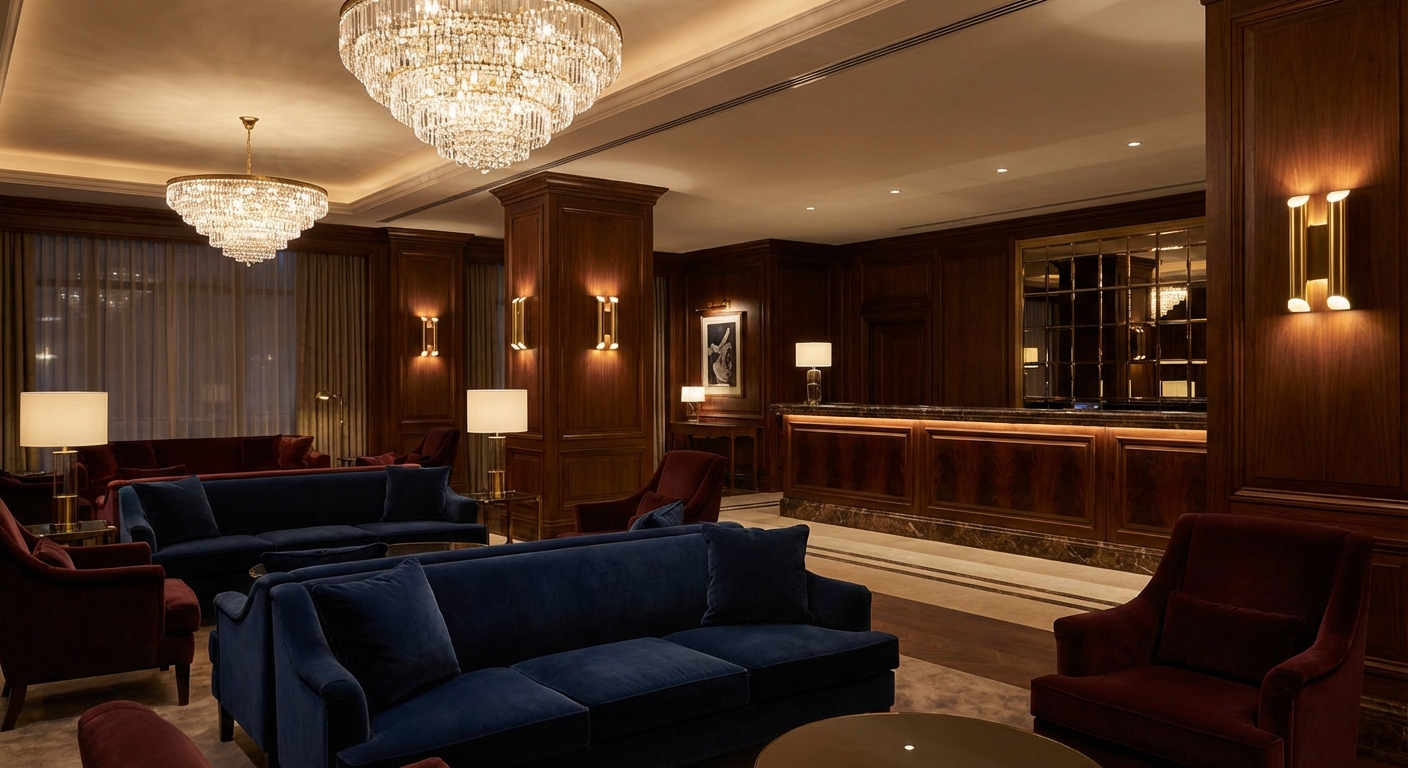
- Design language: bespoke pendants, hand-finished surfaces, multi-material compositions and layered scenes that spotlight art and F&B areas.
- Spec priorities: high CRI (≥ 90), tunable white or multi-channel color for dynamic scenes, custom mounting systems to accommodate unique ceiling treatments.
- Material/finish: hand-polished metals, glasswork, textile shades — require clear maintenance and replacement part strategies.
Sustainability and Energy Codes
- Energy targets: meet or exceed local energy codes and Green Building standards (LEED, BREEAM), often requiring integrated controls and occupancy-based dimming.
- Lifecycle approach: specify LEDs with documented LM-80 / TM-21 data for lumen maintenance and realistic L70 expectations. Consider reparability and modularity to extend service life.
- Certifications: CE/UKCA for EU/UK projects, UL/ETL for North America, ENEC for European electrical safety, and RoHS for materials compliance.
Implementation: From Tender to Turnover
- Document requirements: Include photometric files (IES/LDT), BIM objects, finish samples, and scheduled lead times in tender documents. Require pre-production samples for critical fixture types.
- Batch consistency: Specify color consistency tolerance (≤ 3 SDCM) and specify that fixtures from different production runs must be matched.
- Site logistics: plan for on-site commissioning windows for lighting controls, and include manufacturer support for startup and staff training to ensure programming matches design intent.
Technical Detail: Performance, Certification & Lead Time
Specifying exceptional hospitality lighting requires exacting technical details. Below are critical items to include in your schedule and procurement documents.
-
Color Quality and Stability
- CRI: Specify CRI ≥ 90 for guest rooms and amenity areas where material and skin tones are critical.
- TM-30 if colour fidelity is essential for F&B or wellness spaces.
- CCT: Standardize on CCT ranges per space (e.g., 2700–3000K for guestrooms, 3000–3500K for public zones) and specify tunable white where flexibility is required.
- MacAdam Ellipses: Require ≤ 3 SDCM for color consistency across runs and for replacements.
-
Optical Control & Glare
- UGR/Shielding: For work surfaces in business centres and reception desks, target UGR thresholds. For guest-centric areas, control point-source visibility with deep-set LEDs or diffusers.
- Beam angles: Provide multiple optic options to tailor washes vs. accents; require interchangeable optics for future programming changes.
-
Controls & Integration
- Protocols: DALI-2 with DT8 compatibility, DALI-2 emergency, DMX for theatrical spaces, and BACnet or IP gateways for building-wide integration.
- Commissioning: Include addressing and group mapping as part of the supplier scope. Offer sample scene libraries and commissioning packages.
- Flicker & dimming quality: Specify flicker ≤ 5% and smooth dimming curves to low-light levels for hospitality ambience.
-
Electrical & Safety Certifications
- Fire & emergency: Provide emergency lighting options compliant with local standards (EN 1838/EN 60598, NFPA in US).
- Ingress & robustness: IP ratings per location (IP44 for bathrooms, IP65 for outdoor canopies), IK ratings for high-traffic areas.
- Test reports: Require third-party test reports — LM-80, IP/IK tests, surge protection certifications, and compliance certificates.
-
Manufacturing & Lead Time Assurance
- Production capacity: Request manufacturer confirmation of production slots, buffer stocks, and escalation plans for critical items.
- Lead time clauses: Specify agreed lead times and penalties for delayed delivery on critical-path fixtures. Include staged delivery options for phased openings.
- Sample & mockups: Insist on pre-production samples and on-site mockups for signature spaces to validate finish, scale, and light levels.
“Architects and designers win when lighting specifications are as precise as their drawings — clarity on color, controls, and delivery reduces field risk and protects the design intent.” — Senior Lighting Designer, Artilumen
Risk Mitigation and Procurement Best Practices
- Consolidate where possible: Work with manufacturers that offer a broad portfolio to reduce variability and simplify spares.
- Specify replacements and spares: For each unique fixture type, require a minimum spares pool and clearly document lead times for additional units.
- Factory acceptance testing (FAT): For large or bespoke orders, include FAT to verify photometry, color, and control communication before shipment.
- Warranty & RMA: Define warranty terms (years, lumen maintenance guarantees) and a rapid RMA process for hotels operating 24/7.
Conclusion
2026 is a year where hospitality lighting must deliver both narrative and reliability. Architects and hotel designers should translate the trend vocabulary — minimalism, biophilic accents, and curated luxury — into tightly specified performance criteria that reduce procurement risk and elevate guest experience. Prioritize color consistency, verified lumen maintenance, robust control protocols, and transparent lead-time commitments in your specifications. Artilumen partners with design teams on custom finishes, certified components, and project-level logistics to ensure that design intent is delivered on time and at scale.
Contact the Artilumen team to review specification templates, request BIM and photometric assets, or arrange pre-production mockups and site commissioning support. Let’s ensure your 2026 projects look exceptional and operate reliably from day one.