
Introduction
Selecting the right glass technique for a chandelier is a critical decision for architects and hotel designers. The choice between blown and pressed glass affects not only aesthetic outcome but project risk: lead time, repeatability, quality control, certification and long-term maintenance. For commercial projects—especially hospitality—these factors translate directly into budgeting, coordination with trade partners, guest experience, and regulatory compliance. This article compares blown and pressed glass specifically through the lens of commercial lighting specification, offering practical guidance to mitigate common pain points while aligning design intent with delivery realities.
Key Industry Insight
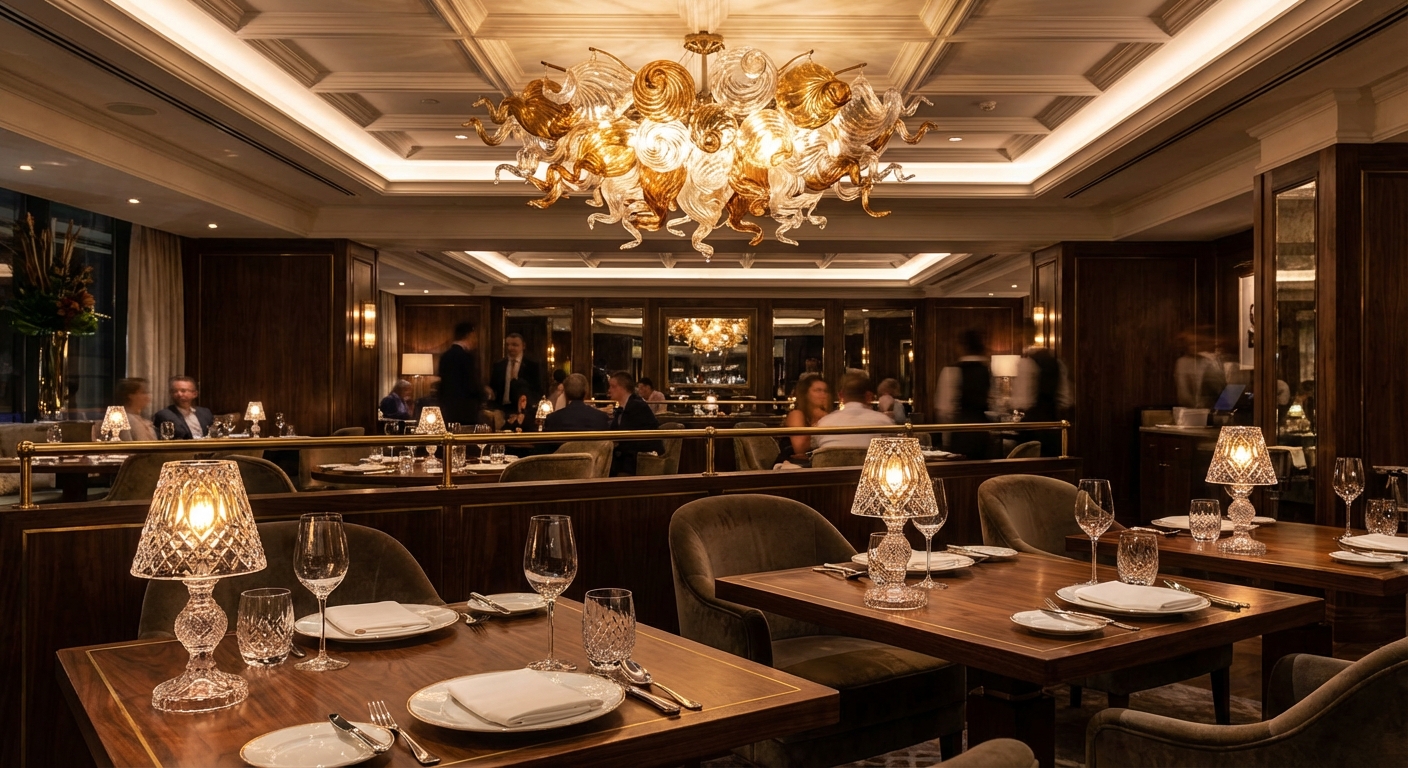
Blown and pressed glass occupy distinct positions in the commercial lighting market. Blown glass is synonymous with artisanal expression, organic form and surface variability; pressed glass is associated with precision, repeatability and cost-efficiency. Understanding the trade-offs is essential when specifying chandeliers for hotel lobbies, ballrooms or signature spaces.
- Quality and Aesthetic Control: Blown glass delivers unique forms and rich internal textures (bubbles, swirls) that communicate craftsmanship. Pressed glass yields uniform prisms, flutes or textured patterns ideal for design systems requiring visual consistency across many fixtures.
- Lead Time and Scalability: Hand-blown components are labour-intensive; typical lead times can be several weeks to months depending on complexity and artisanal capacity. Pressed glass tooling requires upfront investment (molds), but once molds are made, production scales quickly with predictable lead times—important for hotels with tight fit-out schedules or phased rollouts.
- Cost and MOQ: Blown glass commands premium pricing per unit with minimal economies of scale. Pressed glass involves mold costs and higher initial capex, but lower per-unit cost for large runs. Minimum order quantities and staged deliveries should be negotiated up front.
- Certification and Compliance: Both methods can meet commercial safety and photometric standards—but compliance pathways differ. Pressed glass benefits from predictable mechanical and optical properties, simplifying type testing. Blown glass may require more extensive QA documentation to demonstrate consistency, structural safety and compatibility with thermal and impact requirements.
- Design Trends: Current hospitality trends favor bespoke blown-glass centerpieces in lobbies and bespoke suites to create memorable focal points, while pressed glass is trending in modular chandeliers, surface diffusers and backlit systems where performance and repeatability matter.
Technical Detail
Manufacturing, performance and specification details architects and lighting designers should specify and verify.
- Optical Characteristics
- Transparency vs. Diffusion: Blown glass ranges from crystal-clear to intentionally cloudy; it can introduce localized color nuance. Pressed glass can be engineered for consistent diffusion profiles and prismatic light distribution for even illuminance.
- Surface Finish: Hand-blown finishes (e.g., folded rims, pontil marks) add character. Pressed options (polished, frosted, reeded) offer repeatable photometric behavior.
- Mechanical Properties and Safety
- Annealing and Tempering: Both glass types benefit from controlled annealing to relieve thermal stress. For areas with safety requirements (public circulation), specify tempered or laminated variants that comply with EN 12150 / ANSI Z97.1 as applicable.
- Tolerances: Pressed glass tolerances are tighter (±0.5–1.0 mm) than hand-blown parts (±2–5 mm depending on size). Specify acceptable dimensional variance to prevent on-site installation issues.
- Thermal and Photometric Performance
- Heat Management: LED integration reduces operating temperatures, but close-mount glass elements still require thermal compatibility testing. Confirm maximum operating temperatures and fixture rating.
- Photometric Testing: Request LM-79 photometric reports for final assemblies. Pressed diffusers simplify repeatable photometric results; blown pieces should be prototyped and tested to validate light distribution.
- Certification and Documentation
- Electrical and Safety: Ensure luminaire assemblies comply with EN 60598, CE, UL or other regional standards. Documentation should include dielectric tests, ingress protection (IP rating), and impact resistance.
- Environmental and Material Compliance: RoHS, REACH and sustainability credentials (e.g., recycled content in glass) are increasingly important for hospitality owners seeking ESG alignment.
- Installation and Maintenance
- Mounting and Weight: Blown glass pieces can vary significantly in weight and balance. Specify hardware capable of adjustment and secondary supports for large installations. Pressed glass components are more uniform, simplifying mounting and logistics.
- Replacement Strategy: For hotel operations, plan for spare parts—hand-blown pieces are not always interchangeable; specify how many extras to procure and arrange warehousing for replacements.
“For large-scale hospitality projects, treating glass selection as a systems decision—balancing craft, performance and procurement constraints—reduces risk and preserves design intent.”
Practical Specification Guidance
- When to Choose Blown Glass
- Best for bespoke statement pieces where uniqueness is a selling point—hotel atria, VIP suites, signature bars.
- Specify sample approvals and a minimum of three physical prototypes. Include a clear sign-off stage for color, thickness and surface texture.
- Anticipate longer lead times and include allowances in the project schedule (typically 8–16 weeks depending on complexity).
- When to Choose Pressed Glass
- Best for repeatable, high-volume fixtures (corridor pendants, wall sconces, bathroom vanity lights) where consistency and schedule are priorities.
- Negotiate mold lead time and cost allocation early. For phased projects, ensure mold ownership or licensing terms to facilitate later runs.
- Pressed glass is preferable where uniform photometrics and interchangeability are critical.
- Hybrid Approaches
- Combine blown decorative components with pressed diffusers to achieve both visual impact and repeatable performance. This allows a signature look at lower overall risk and cost.
- Procurement and QA Process
- Request full material and process traceability: annealing curves, tempering certificates, and production batch photos.
- Insist on photographic and dimensional reports for each shipment batch, and specify acceptance criteria for visible surface defects and optical anomalies.
- Reserve time for on-site mockup installation—testing balance, cable runs and maintenance access—before final production.
Risk Management and Logistics
- Supply Chain Resilience: Artisanal blown glass studios may have limited capacity. Establish lead-time buffers and secondary suppliers for critical projects. Consider local partnership options to reduce shipping delays and customs risk.
- Packaging and Transport: Glass requires engineered packaging for transit. For blown glass, use nested crates and vibration-damping inserts. Confirm international transport insurance and handling protocols to avoid costly on-site delays.
- Cost Transparency: Request itemized quotes that separate art-labour, mold costs (for pressed), finish treatments and testing fees. Hidden costs often arise from expedited production or reworks due to insufficient sample approvals.
Design Trends and Guest Experience
- Experiential Lighting: Blown glass chandeliers create an artisan narrative that contributes to brand storytelling in luxury hotels. Thoughtful integration with audio-visual and architectural finishes elevates guest perception.
- Sustainable Luxury: Recycled glass and low-energy LED integration are rising expectations. Specify recycled-content glass where possible and request life-cycle assessments for major fixtures.
- Adaptive Systems: Designers are pairing static blown-glass sculptures with modular LED engines for flexible color temperature and dimming profiles—this keeps the visual identity while allowing programmable scenes for different hotel functions.
Conclusion
Choosing between blown and pressed glass for chandeliers is a strategic decision that affects aesthetics, schedule, budget and compliance across a hospitality project. For focal statement pieces where uniqueness and artisanal value matter, blown glass remains unrivaled—provided you plan for longer lead times, stricter QA and spare-part strategy. For repeatable, budget-conscious implementations where consistent photometrics and faster delivery are priorities, pressed glass offers predictability and scale.
Artilumen partners with architects and hotel designers to translate design intent into executable specifications: from sample prototyping and photometric testing to certification support and logistics planning. Contact the Artilumen team to review your project requirements, request sample units, or arrange a technical consultation to optimise material choice, lead times and compliance for your chandelier installations.