
Introduction
Lighting decisions in hospitality are no longer aesthetic afterthoughts; they are strategic drivers of guest perception, operational efficiency, and lifecycle cost. For architects and hotel designers specifying commercial lighting, color temperature (CCT) choices—most commonly 2700K, 3000K, and 4000K—play a decisive role in how a dining space reads to guests, how food is perceived, and how spaces perform across service periods. This article focuses on clarifying the technical and design trade-offs of these CCTs and translating them into practical specification guidance that addresses common B2B pain points: product quality, lead time, design trends, certifications, and integration with controls and BIM workflows.
Key Industry Insight
Color temperature is a primary tool for sculpting mood. But in commercial projects the decision cannot be aesthetic-only. It must account for brand positioning, operational requirements, energy codes, maintenance, and procurement realities.
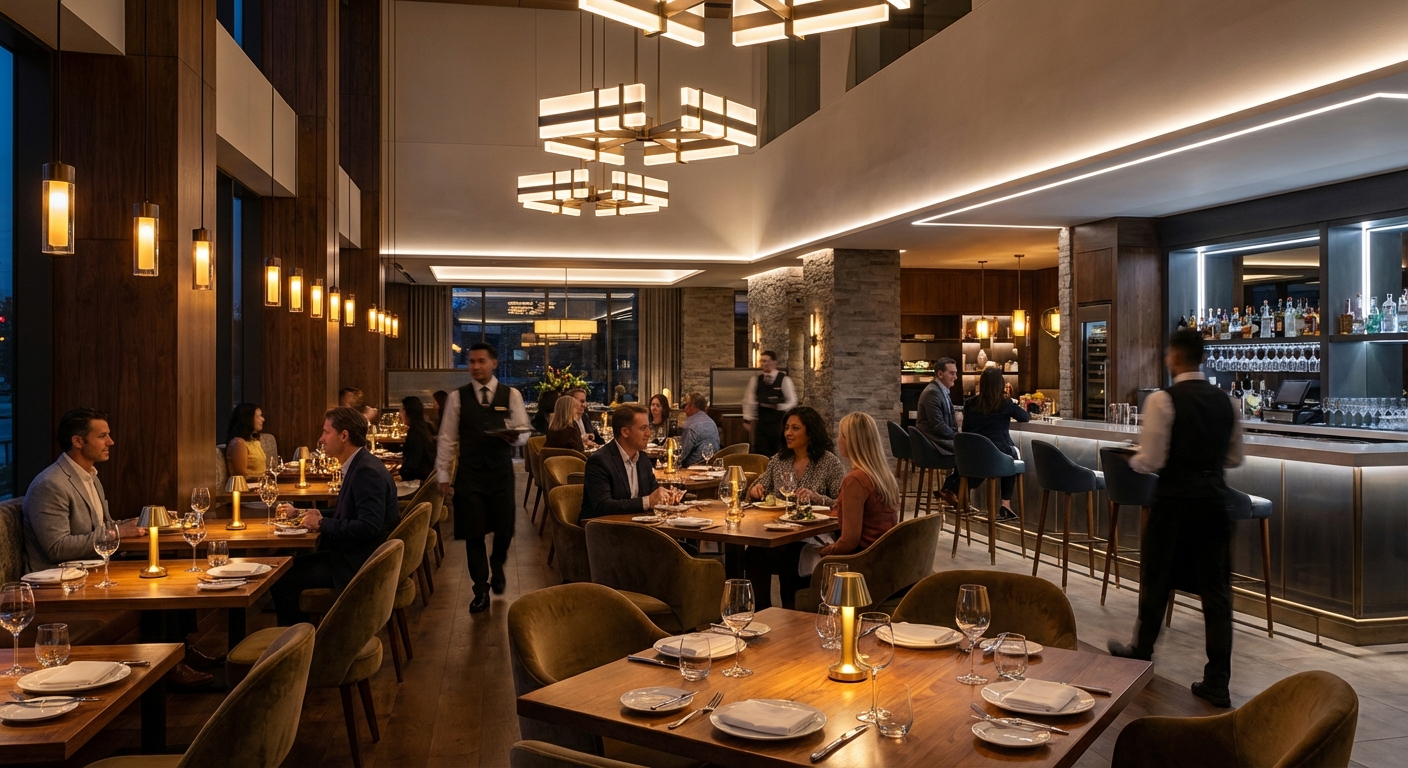
- Brand and guest experience: 2700K is traditionally used for intimate, high-end dining where warmth and softened skin tones are desired. 3000K strikes a balance—warm yet modern—suitable for most mid-to-upscale restaurants. 4000K reads as clean and efficient, appropriate for fast-casual, open kitchens, and back-of-house areas where color fidelity and task clarity are priorities.
- Food presentation: Reds and warm hues are crucial to appetizing food appearance. LEDs with appropriate spectral power (high CRI and elevated R9) at 2700K or 3000K will render food more appealing. A 4000K source with poor spectral rendering can make dishes look flat or washed out.
- Operational periods and tunability: Restaurants often transition between service modes (brunch/lunch/dinner) where ambience expectations change. Tunable white or warm-dim solutions allow a single fixture to serve multiple atmospheres, reducing product variety and simplifying maintenance logistics.
- Design trends and longevity: Current hospitality design trends emphasize layered lighting—ambient, accent, and task—that work together. Selecting a consistent CCT across ambient fixtures with controlled accent temperatures permits tighter visual coherence while allowing targeted pops of contrast for feature walls or artwork.
- Procurement realities: For large rollouts, batch-to-batch chromatic consistency is vital. Specify SDCM ≤3 and require manufacturer-provided chromaticity coordinates, LM-79 photometric data, and TM-30 reports to ensure the delivered solution matches the design intent.
- Certification and compliance: Architects must verify compliance with regional energy codes and desired certification schemes (DLC, ENEC, CE, UL). For hospitality, certifications tied to performance and energy savings often impact rebate eligibility and long-term operating cost models.
Technical Detail
Translating CCT choices into specifications requires attention to spectral metrics, photometry, control protocols, and long-term reliability.
- Correlated Color Temperature (CCT) vs Spectral Power Distribution (SPD)
- CCT (2700K, 3000K, 4000K) is a shorthand for perceived warmth. SPD and CRI/TM-30 reveal the true rendering quality. Request SPD graphs and TM-30 fidelity/gamut numbers in the submittal stage.
- Color Rendering Index (CRI) and R9
- Specify CRI ≥ 90 for dining areas where food and skin tones must appear natural. Insist on R9 (strong red) values—R9 ≥ 50 is a minimum for high-quality food rendering; higher where food photography or presentation is paramount.
- TM-30 and spectral fidelity
- TM-30 provides more nuanced metrics than CRI. Ask for Rf and Rg values; aim for Rf ≥ 85 and controlled Rg to avoid oversaturation. TM-30 data help avoid unpleasant color shifts and ensure consistency across fixture types.
- Binning and SDCM
- Require ≤3 SDCM (MacAdam steps) for consistent appearance across fixtures and installations. For high-end hospitality spaces, ≤2 SDCM is preferable.
- Photometry and BIM deliverables
- Request LM-79 files, IES photometric files, and BIM families early in the specification to run lighting calculations (uniformity ratios, vertical illuminance for sightlines) and coordinate with MEP and interior elements.
- Lifetime testing and warranties
- Specify LM-80 reports for LED modules and TM-21 projections for lumen maintenance. Default to L70 at 50,000 hours or better, backed by a minimum 5-year warranty with options for extended service agreements.
- Controls and protocols
- Define required control compatibility—DALI Type 8, 0-10V, DMX, or modern networked lighting control (PoE, Tunable White over DALI2). Ensure manufacturers can supply drivers with specified dimming curves, warm-dim performance if required, and field-upgradeable firmware.
- Glare, beam control, and mounting
- Use beam control optics, baffles, and glare shields to prevent direct sightline brightness, particularly for pendant fixtures over dining tables. Specify UGR limits for visible task areas when needed and provide mounting details (suspension lengths, canopy options) on shop drawings.
- Energy codes and rebates
- Confirm fixtures meet regional efficiency standards and check DLC/ENERGY STAR listings where rebate programs exist. Higher initial cost fixtures with better lumen maintenance and controls typically yield lower life-cycle costs.
“Selecting the right color temperature is as strategic as choosing finishes; it defines mood, elevates food presentation, and ensures operational consistency across a property’s lifecycle.”
Practical Recommendations for Specifiers
- 2700K — Use for intimate, fine-dining areas where warmth and relaxation are priority. Pair with high-CRI (≥90) LEDs and warm-dim capability to deepen warmth as evening service progresses. Typical illuminance: ambient 50–150 lux, table-level accent 150–300 lux depending on concept.
- 3000K — The most versatile choice for ambient lighting in upscale-casual and modern dining, offering a familiar warmth with contemporary clarity. Use for lounge areas, general seating, and where a balance between mood and task is required. Recommend CRI ≥90 and TM-30 documentation.
- 4000K — Best for fast-casual, open kitchens, service corridors, and areas that prioritize color accuracy and operational efficiency. If used in dining zones, pair with accent lighting at lower CCT for visual warmth and to protect guests’ comfort. Consider 4000K in transition zones to reinforce wayfinding and staff efficiency.
- Warm-dim and tunable white strategy — Where budgets allow, specify warm-dim (color shifts toward 2200K at low dim levels) or full tunable white systems to accommodate multiple service modes without changing fixtures. This reduces future redesign costs and can simplify stocking and maintenance.
- Accent and spotlighting — Use slightly higher CCT for accent fixtures when you want to enhance texture or highlight architectural materials. Coordinate with ambient CCT to avoid visual clashes; small shifts (e.g., ambient 2700K with artwork accent 3000K) can be used deliberately for contrast.
- Samples and mock-ups — Insist on on-site mock-ups with final finishes and set dressing. Photometric data alone cannot substitute for real-world validation of how food, textiles, and skin tones interact with chosen CCT and fixtures.
Specification and Procurement Checklist
- LM-79 photometry and IES files for each fixture
- LM-80 data and TM-21 lumen maintenance projections
- TM-30 reports and SPD graphs
- CRI (≥90) and R9 values documented
- SDCM ≤3 and chromaticity coordinates (x,y)
- Driver and control protocol compatibility (DALI, 0-10V, DMX, PoE)
- Warranty terms and service options
- BIM objects, CAD blocks, and shop drawings
- Lead time, MOQ, and sample availability
- Certifications: DLC, CE, UL/ETL depending on region
Managing Lead Time and Quality Risk
Large hospitality rollouts often face the dual pressures of tight opening schedules and high aesthetic standards. Mitigate these risks by:
- Early engagement with your lighting manufacturer to lock chromaticity targets and production slots.
- Requesting pre-production samples and pilot runs for color and dimming behavior.
- Specifying acceptance criteria in contracts (photometry tolerances, delivery windows, corrective remedies).
- Consolidating fixture families where feasible to reduce SKUs and lead-time complexity.
Conclusion
Color temperature is a powerful tool in the architect and hotel designer’s toolkit—when specified with technical rigor. Choosing between 2700K, 3000K, and 4000K is not simply a matter of “warmer vs cooler”; it requires consideration of spectral quality, render fidelity, controls integration, maintenance lifecycle, and procurement logistics. For hospitality projects, the right combination improves guest experience, strengthens brand positioning, and reduces long-term operational friction.
Contact the Artilumen team to discuss project-specific CCT strategies, request LM-79/LM-80 data, order mock-up samples, or obtain BIM families and lead-time estimates. Our specification specialists collaborate with design teams to ensure lighting delivers on ambience, certification, and installation timelines. Let’s align light quality with your design intent and operational requirements.