
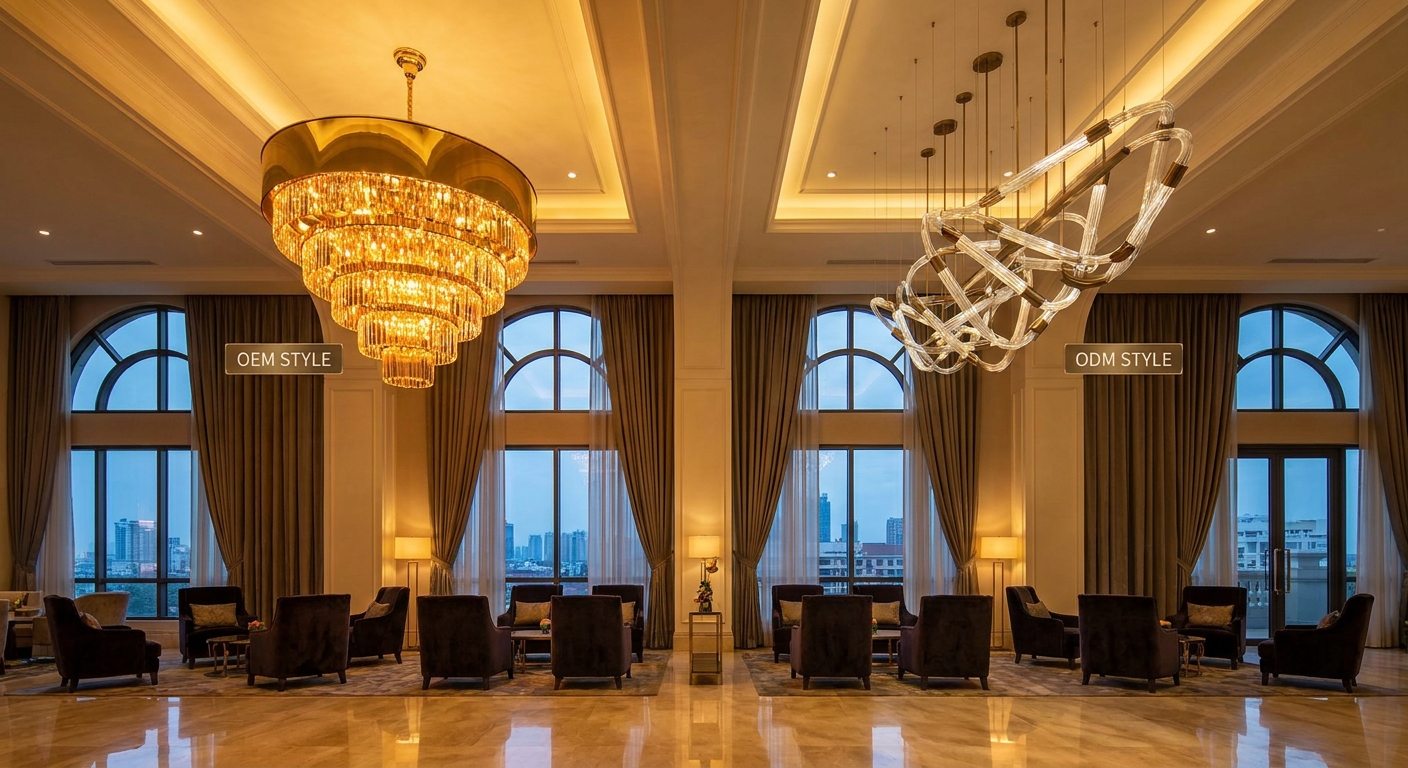
Introduction
Selecting the right manufacturing partnership—OEM (Original Equipment Manufacturer) or ODM (Original Design Manufacturer)—is a strategic decision that shapes product quality, delivery reliability, and brand differentiation. For architects and hotel designers specifying luminaires into high-stakes hospitality and commercial projects, the choice influences everything from installation timelines and maintenance budgets to guest experience and regulatory compliance. This article breaks down the practical differences between OEM and ODM for lighting brands, focusing on the core B2B pain points: quality assurance, lead times, design control, certification, and long-term risk management.
Key Industry Insight
The lighting sector has matured beyond simple commodity sourcing. Specifications now demand predictable photometric performance, long-term color stability, integrated controls, and verified safety certifications. Architects and hotel design teams require partners who not only deliver lumens but also ensure consistency across production runs, meet local and international compliance requirements, and align with evolving design trends—human-centric lighting, warm-dimming solutions, and integrated IoT controls. The choice between OEM and ODM hinges largely on how much control your brand needs over design, IP and supply chain versus how much you prioritize speed-to-market and cost-efficiency.
Defining OEM and ODM in Practice
- OEM: You provide a proprietary design, specifications, drawings, and often the bill of materials. The manufacturer produces to your exact requirements. This model favors brands that need strict design control, unique IP protection, and custom engineering (special optics, unique thermal solutions, bespoke finishes).
- ODM: The manufacturer offers an existing design platform that you can adapt—finishes, control options, lumen packages—without owning the full design or tooling. ODMs enable faster launches, lower NRE (non-recurring engineering) costs, and simplified procurement for repeatable, standardized products.
Pros and Cons for Architects and Hotel Designers
- OEM Pros: Full customization, unique brand aesthetic, direct control over driver selection, optics, and thermal management, easier to secure patents, stronger QA alignment with project specs.
- OEM Cons: Higher tooling and development costs, longer development and approval cycles, higher minimum order quantities (MOQs).
- ODM Pros: Faster lead times, lower initial investment, established production processes, simplified procurement and warranty handling.
- ODM Cons: Limited design uniqueness, dependence on manufacturer’s existing components, potential compromise on materials or certs.
Procurement and Contract Considerations
- Minimum Order Quantities: Negotiate phased MOQ or pilot production runs to de-risk large capital outlays for hotels with multiple properties or phased rollouts.
- IP and NDAs: For OEMs, include IP ownership clauses and clearly defined deliverables. For ODMs, confirm what branding and customization rights you retain.
- Warranties & Spares: Define warranty terms, lead times for spare parts, and on-site failure response times—critical for hotel operations where downtime directly affects revenue.
Technical Detail
Technical specifications are where project success is won or lost. Below are the essential technical considerations to specify and verify during OEM or ODM engagement.
- Photometric Performance: Request IES files and full photometric reports. Confirm delivered fixtures match specified lux levels and uniformity in real installations.
- Lumen Maintenance and Lifetime: Require LM80 reports for LED sources and TM-21 projections for lumen maintenance (e.g., L70 at 50,000 hours). This directly impacts maintenance schedules and lifecycle costs for hotels.
- Color Quality and Consistency: Specify CCT ranges (2700K–3000K for many hospitality spaces), CRI (minimum CRI 90 for high-end interiors), and MacAdam step tolerance (preferably 3-step or better for visible consistency across fixtures).
- Drivers and Controls: Insist on high-quality drivers (Mean Well, Inventronics, Philips/Tridonic, etc.) and controls compatibility—DALI-2, 0–10V, DMX, or wireless protocols like Casambi or Zigbee depending on the project scale. Confirm surge protection (kV rating) where infrastructure risks are present.
- Thermal Management: Aluminum extrusion, adequate heatsinking, and thermal interface testing prevent early lumen depreciation. For OEMs, demand thermal simulation data; for ODMs, ask for performance under worst-case ambient conditions.
- Mechanical & Environmental Ratings: Specify IP ratings for wet areas (IP65/IP66 for façades and outdoor fixtures), IK ratings for impact resistance, and finishes tested for salt-spray if coastal projects are involved.
- Safety & Energy Certifications: Require CE, UKCA, UL (for North America), ENEC (for Europe), and local energy program qualifications (DLC or Energy Star where rebate eligibility matters).
- Materials & Finish Durability: Detail powder-coating specs, anodizing thickness, and corrosion resistance for long-term finish integrity in hospitality environments.
Supply Chain, Lead Time & Quality Control
- Lead Time Expectations: ODM pathways can reduce time-to-market by 30–50% because designs and tooling are pre-existing. OEM development cycles typically require 8–20 weeks for prototyping and validation before mass production.
- Samples and Prototyping: Always evaluate pre-production samples and on-site mock-ups. For OEMs, include an agreed number of iterative prototypes in the contract. For ODMs, request certified sample runs to verify specified performance.
- Factory Audits & QA Processes: Require ISO 9001 certification, production process documentation, and third-party testing. Use AQL sampling criteria during production inspection and ensure IQC (incoming quality control), PQC (process quality control), and FQC (final quality control) are enforced.
- Inventory & Logistics: Negotiate phased deliveries, consignment stock, or safety stock arrangements to mitigate shipping delays and port congestion. Consider local warehousing strategies for multi-property hotel rollouts.
“For hospitality projects, manufacturing partnership is not just about price—it’s about predictable photometric performance, certification integrity, and a supply chain you can rely on across multiple properties.”
Implementation Strategy: When to Choose OEM vs ODM
-
Choose OEM if:
- You require unique aesthetics or patented features.
- You need strict control over optical systems, thermal management, and driver selection.
- Your brand positions itself on differentiated product design and performance.
- You can accommodate longer lead times and higher upfront development costs.
-
Choose ODM if:
- Speed-to-market and cost containment are primary drivers.
- You accept platform-level design with branded modifications.
- Your project benefits from proven, tested product families with established components and certifications.
- You are managing multiple small projects or retrofits where rapid delivery and lower MOQ are advantageous.
Risk Mitigation Steps (Both Models)
- Specify acceptance criteria and sample approval milestones in purchase orders.
- Require third-party verification for photometry and safety certifications.
- Negotiate service-level agreements (SLAs) for lead times, replacement parts, and on-site support.
- Maintain a dual-supplier strategy for critical components (LED chips, drivers) to avoid single-source failure risks.
Conclusion
For architects and hotel designers, the decision between OEM and ODM is strategic rather than purely transactional. OEM partnerships deliver bespoke performance and brand differentiation at a higher upfront cost and longer lead time; ODM partnerships offer speed, lower development risk, and cost advantages but with compromises on uniqueness. The right choice depends on your project priorities: design control, certification requirements, lifecycle costs, and timing.
If you are specifying luminaires for hospitality or commercial architecture and need an expert assessment, Artilumen can evaluate your project constraints, propose OEM vs ODM strategies, and develop a tailored plan covering photometry, certifications, controls integration, and production scheduling. Contact the Artilumen team to schedule a technical consultation and prototype review for your next project.