Introduction
Designing lighting for a boutique hotel is a multidimensional challenge: aesthetics must inspire, technical performance must ensure reliability, and procurement must fit tight construction schedules and budget constraints. For architects and hotel designers, the path from concept sketches to finished spaces is paved with choices that affect guest perception, operational cost, maintenance, and regulatory compliance.
This article explains how Artilumen approaches boutique hotel lighting projects end to end: early collaboration, staged delivery, photometric control, and certification management. We focus on the B2B pain points that matter most to specifiers — product quality and testing, lead time and logistics, design and trend alignment, and certification and compliance. The process described is reproducible for hospitality projects with similar complexity.
Key Industry Insight
Successful hospitality lighting projects require an integrated approach that aligns design intent with manufacturing realities and regulatory requirements. In boutique hotels — where every fixture can be part of the brand story — designers demand flexibility: bespoke finishes, custom optics, tailored control schemes, and predictability in delivery. At the same time, hotel developers and operators demand durability, low total cost of ownership, serviceability, and documented compliance.
Common pain points architects and hotel designers report:
- Quality uncertainty: Are CRI, lumen maintenance (L70/L80), and color consistency across batches going to hold up over the lifecycle?
- Lead-time pressure: How do you meet aggressive opening dates when key luminaires are bespoke?
- Certification risk: Will fixtures meet local fire, electrical, and energy codes, plus global standards for procurement chains?
- Integration complexity: How do lighting control systems (DALI, BLE mesh, PoE, DMX) integrate with room management, energy monitoring, and emergency lighting?
Artilumen addresses each of these areas by integrating early-stage collaboration, engineering controls, and production safeguards into the project timeline.
A typical boutique hotel brief
A representative boutique hotel brief calls for:
- Distinct identity across lobby, F&B, spa, corridors, and guest rooms.
- Warm, welcoming public spaces with layered light scenes.
- Tunable white in bedrooms for circadian support and guest preference.
- Small-batch, custom-finished decorative pendants for the lobby and restaurant.
- Tight client opening date with a 6-month fit-out window.
- Compliance with regional CE/EN standards and LM-79 photometric documentation for owner handover.
From the outset, Artilumen proposes a phased delivery strategy: early release of standard critical-path fixtures, concurrent development of bespoke decorative luminaires, and prioritized testing and certification to de-risk procurement.
Technical Detail
Technical execution splits into four workstreams: optics & photometry, electrical & controls, mechanical & finishes, and compliance & testing.
Optics & Photometry
- CRI and color consistency: We specify high-CRI (≥90) LED packages and perform binning controls to limit Delta C and maintain consistent color temperature across production lots. For public spaces where tonal warmth is crucial, 2700K ±150K is used with tight MacAdam step control.
- Lumen output and distribution: IES files and lumen maps are generated early. We use full-room photometric simulations to validate lux levels for reception desks (300–500 lux task areas), dining tables (150–300 lux), corridors (75–150 lux), and bedrooms (50–150 lux with layered task lighting).
- Optical customization: Custom PMMA lenses and micro-reflectors are engineered to avoid glare in the lobby while providing accent pools over artwork and seating clusters.
Electrical & Controls
- Tunable white and scene control: Guest rooms implement 2-channel DALI DT8 solutions enabling tunable white (2700K–4000K) and pre-set scenes integrated with the PMS. Public spaces use DALI-2 and Bluetooth mesh lighting for flexibility during events.
- Dimming performance: Flicker metrics are tested to meet IEEE 1789 recommendations for low-flicker operation across dimming ranges, important for camera-intensive spaces and guest comfort.
- Emergency and redundancy: Emergency luminaires integrate with central battery cabinets where required; photometric maintained for safe egress while minimizing visual disruption.
Mechanical & Finishes
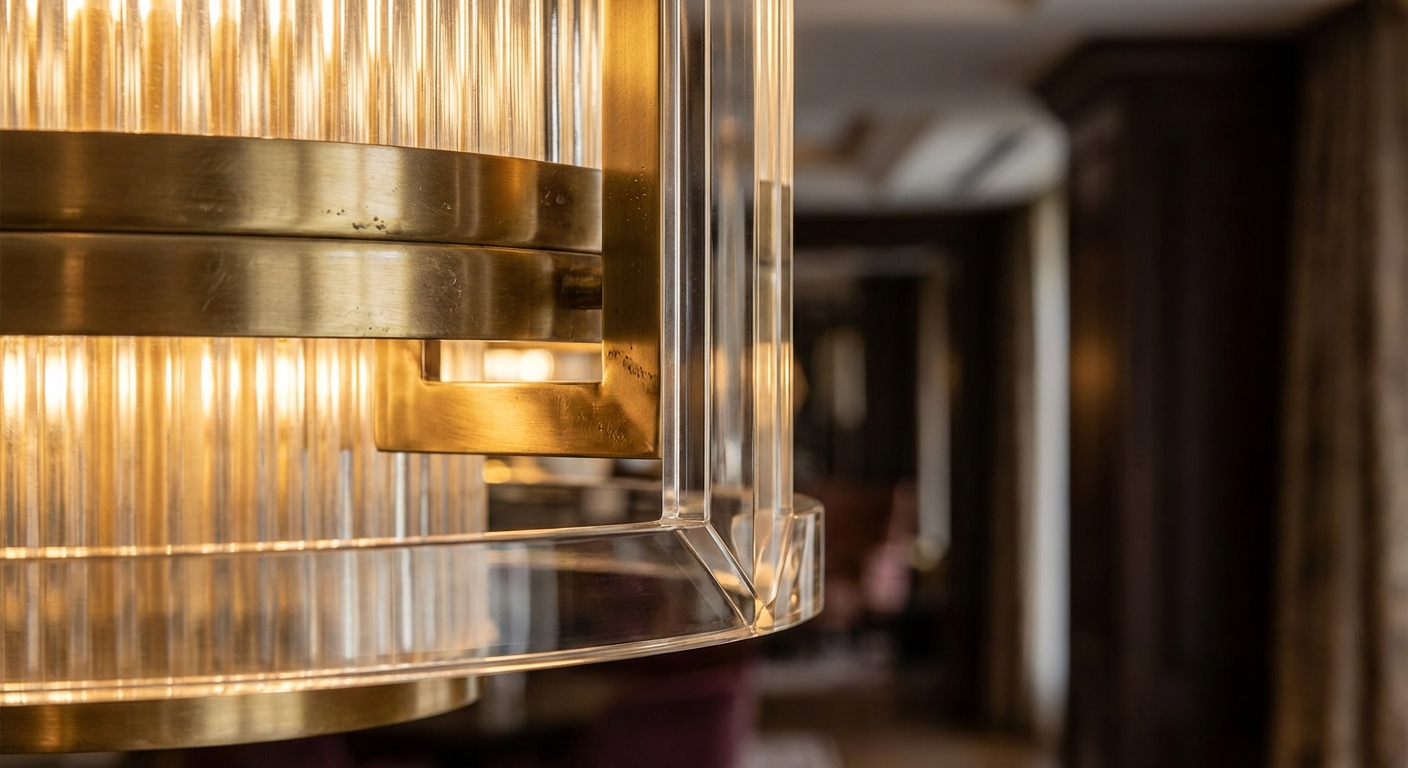
- Small-batch decorative manufacturing: Decorative pendants are produced with interchangeable trims and finishes. Anodized aluminum and wet-painted brass alternatives are prototyped; physical samples are typically produced within 4 weeks for client approval.
- Serviceability: All fixtures are specified with replaceable LED modules and driver access points to reduce future replacement time and cost. Corridor downlights use quick-release mechanisms to minimize room closures during maintenance.
Compliance & Testing
- Certification documentation: Full LM-79 reports, TM-21 extrapolations for lumen maintenance, and IP/IK test results are provided. Artilumen manages the CE declaration process and provides manufacturer declarations, fire resistance verifications for recessed fittings, and UL/ETL options where required for international procurement.
- In-house and third-party testing: We combine in-house life-testing with accredited labs for independent verification, giving design teams and clients confidence in warranties and predicted lifetimes.
Lead-time and Delivery Management Lead time pressure is one of the most significant risks in hospitality projects. Artilumen mitigates this through:
- Critical-path staging: Prioritizing production of fixtures needed for early trade installs (corridors, back-of-house, critical public zones).
- Modular design: Where custom looks are requested, we use standardized internal LED modules with bespoke outer shells. This preserves performance predictability while allowing design differentiation.
- Sample and sign-off sprint: A two-week rapid sample loop is agreed upon to expedite approvals. Digital mock-ups and AR overlays accelerate decision-making when physical site access is restricted.
- Stock buffers and local logistics: For repeatable SKUs, Artilumen ships from regional warehouses to reduce customs delays and provide replacement units during commissioning.
Design Trends Considerations Current hospitality lighting trends guide material and lighting decisions:
- Layered lighting: Combining architectural ambient, decorative focal, and task lighting to support both intimacy and functionality.
- Human-centric lighting: Tunable white controls in guest rooms and dynamic scenes in public spaces to support circadian rhythms and mood-based experiences.
- Sustainable sourcing: High-efficiency LEDs, low-maintenance designs, and recyclable materials with RoHS and REACH compliance.
- Minimal decorative statements: Fixtures function as refined accents rather than overbearing elements — congruent with boutique aesthetics.
Cost and Value Engineering Value engineering focuses on reducing long-term OPEX rather than cutting initial spec quality. Substitutions prioritize:
- Long-life LEDs and higher-efficiency drivers to reduce replacement cycles and energy use.
- Replaceable optical modules that allow fixture shells to remain in place for years.
- Centralized controls to optimize energy management and reduce lamp-on hours.
“Lighting for hospitality is not only a technical specification—it’s an engineered experience. Successful installations balance optical precision, reliable manufacturing, and controls integration to protect both opening schedules and brand intent.”
Conclusion
For architects and hotel designers, the pathway to an exceptional boutique hotel lighting scheme lies in collaboration with a lighting partner who anticipates project risks and brings engineering discipline to the creative brief. Artilumen’s approach — early collaboration, staged delivery, tight photometric control, and rigorous certification — addresses the core pain points of hospitality projects: reliable quality, compressed lead times, regulatory certainty, and design fidelity.
If you are specifying or designing a hospitality project and need a partner who can translate nuanced design intent into manufacturable and certifiable lighting solutions, contact the Artilumen team. We provide product samples, photometric packages, BIM objects, and a dedicated project manager to align manufacturing milestones with your construction schedule. Reach out to discuss how we can support your next boutique hotel project and ensure your lighting is both beautiful and buildable.